Superintendent Battle
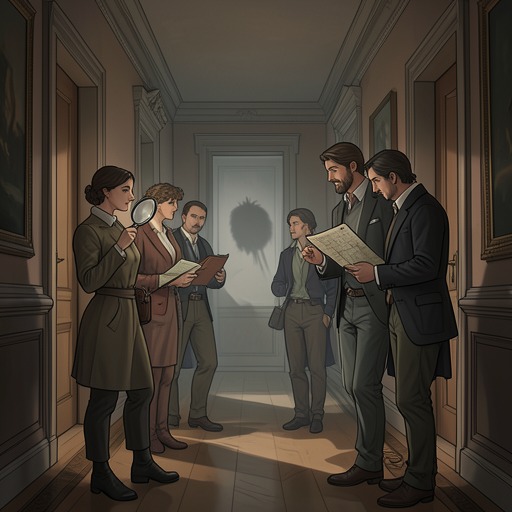
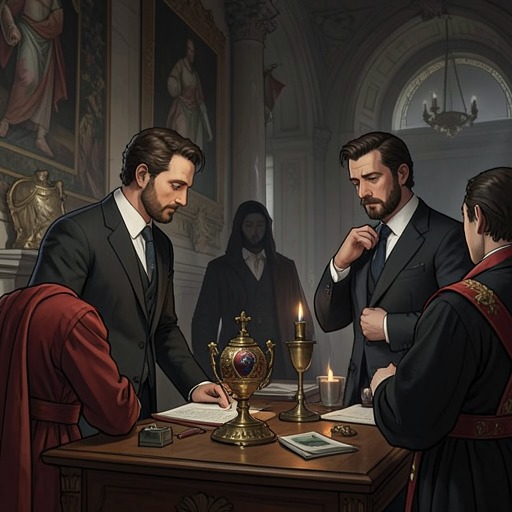
The Secret of ChimneysSuperintendent Battle is the Scotland Yard detective called to investigate the killing at Chimneys after George Lomax decides that the local police cannot be trusted with a politically delicate case. Quiet in manner and exacting about evidence, Battle brings a professional method to a household crowded with competing explanations. His investigation eventually intersects with Anthony Cade’s concealed past: Battle suspects that Cade is withholding something, yet does not mistake suspicion for proof of murder.
Appointment and Method
When a dead body makes secrecy impossible, George Lomax agrees that local police involvement will not suffice and insists that the case requires Battle, whom he knows from an earlier inquiry into party funds. Battle arrives at Chimneys with the chief constable, Colonel Melrose, and has already surveyed the scene with Inspector Badgworthy and Dr Cartwright. Lomax stresses the need for discretion; Battle accepts the sensitivity of the case but refuses to let political secrecy become concealment from the investigators. He asks whether the dead man, known to the household as Count Stanislaus, was using his real name, immediately establishing that identity itself must be tested rather than accepted as fact.
Battle’s method is patient rather than theatrical. When Lomax asks whether the murderer entered through the window, Battle pauses before giving the evidence: footsteps ran both toward and away from it; a car stopped outside the park at 11:40 the previous night; and, at midnight, a young man arrived by car at the Jolly Cricketers and took a room. The man’s boots, left outside for cleaning, were wet and muddy, as if he had crossed the park’s long grass. The sequence gives the household a plausible line of inquiry, but Battle does not present it as a complete solution. Later, he points out a detail that complicates the apparent outside entry: when the crime was discovered, the middle window was open, not latched.
The Chimneys Inquiry
Battle’s caution matters because Anthony Cade has arrived at the scene burdened by his own involvement in another crime. Cade knows that his earlier conduct would not withstand scrutiny, and decides to give a version of events with one alteration and one serious omission. When he recounts his recent history, he names James McGrath, the Canadian currently in Africa, a connection that makes George react sharply. Battle’s investigation therefore proceeds in an atmosphere where statements may be truthful in part while still withholding crucial context.
The open window changes the possibilities rather than settling them. Cade observes that someone inside the house might have unlatched it after he left, making the murder look like an outside job and implicating him; alternatively, Cade himself might be lying. Battle responds with a firm restriction: nobody will leave Chimneys until he has finished with them. The order turns the household into a bounded field of inquiry, giving him time to test its members and their accounts rather than allowing uncertainty to disperse with them.
Battle also recognizes that the political stakes reach beyond the immediate household. He tells Herman Isaacstein that both Isaacstein and Lomax, as well as the Herzoslovakian Loyalist Party, are in serious difficulty. His blunt assessment draws a contrast with Lomax’s concern for appearances: Isaacstein accepts the description as apt, while Lomax objects to Battle’s manner. Battle nevertheless acknowledges Isaacstein as a powerful personality, showing that he can assess a suspect’s force without confusing it with innocence or guilt.
He deliberately leaves the Prince’s servant, Boris Anchoukoff, until last among those he wishes to question. This is part of a broader interview strategy: Battle does not simply follow the household’s most prominent voices, but reserves a witness whose position may give him a different view of the Prince and the events around him. The evidence presented here establishes the decision and its timing, rather than the outcome of that particular examination.
Partnership and Disclosure
Battle invites Cade to work with him, describing the value of combining a professional investigator’s experience with an amateur’s intimacy with the circumstances. Cade admits that he has long wanted to try solving a murder mystery and accepts the invitation. The partnership is practical, but never uncomplicated: Cade has knowledge Battle needs, while also having reasons to keep parts of his own conduct hidden.
Battle’s willingness to share information extends beyond Cade. He argues that Lomax’s efforts to preserve secrecy cannot continue indefinitely and that Bill Eversleigh, as Lomax’s secretary, should be told what is relevant. Cade, too, has been drawn into the affair and has a right to understand it. Battle’s position is not indiscriminate openness; it is a judgment that secrecy has begun to obstruct the people who need to act on the truth. His insistence makes information-sharing part of the investigation’s practical ethics.
The relationship with Cade develops through a measured exchange of trust. Battle asks why Cade has chosen to disclose what he knows at this stage. Cade says he has come to respect Battle’s abilities and no longer wants to cramp the investigation by withholding facts. He had previously held back for Virginia Revel’s sake, but argues that her statement about paying a man to suppress letters would be difficult for a jury to believe if detached from its explanation. Battle agrees that juries can lack imagination. His response shows that he understands how a technically suspicious account may become misleading when stripped of human context, while still requiring it to be tested.
The Lemoine Deception and the Case’s Resolution
Battle has arranged to work with the French detective M. Lemoine, but Lemoine’s delayed arrival becomes a puzzle in its own right. Battle had been informed from Paris that Lemoine was coming; when the supposed colleague finally explains himself, he says he arrived the morning after the murder and deliberately remained unofficial. By appearing as an object of suspicion, he hoped to avoid alerting the people he was pursuing. Battle’s uncertainty about where the real Lemoine had gone is therefore not a lapse in attention but a clue to the imposture surrounding the case.
The investigation’s later confrontation makes Battle’s caution visible. When M. Lemoine suspects Cade of being King Victor, Battle moves nearer the door, apparently ready to prevent an escape. Cade remains composed and challenges the accusation. Lemoine says that fingerprints and Bertillon measurements of King Victor, also known as Captain O’Neill, have been sent from France. Battle then intervenes to confirm that the man who impersonated Prince Nicholas in America was indeed an impostor. That fact matters because it separates the fraudulent American claimant from the genuine Prince Nicholas; it does not, by itself, identify Cade as the criminal Lemoine alleges.
In the later explanation, Cade recounts going to Dover, with Hiram Fish following under the belief that Cade was King Victor. There they found a mysterious prisoner; hearing his account revealed the familiar pattern of a real person being kidnapped while an impostor took his place. Cade also explains that Battle had distrusted his French colleague and had wired Paris for identifying materials, including fingerprints. Battle’s suspicion had led to a test capable of checking identity, rather than relying on a convincing name or performance. The impostor had used the accusation against Cade to create a diversion and keep everyone in one room while an accomplice was alerted about the diamond.
What Battle Suspects—and What He Knows
Battle’s conduct toward Cade is shaped by a distinction between concealed motive and demonstrated guilt. Cade acknowledges that, as the next heir to the throne, he could have been supposed to benefit from Prince Michael Obolovitch’s death, and says he feared Battle throughout the investigation because he felt the detective suspected him. Battle confirms that Cade puzzled him: he sensed that Cade was afraid of something, but lacked a motive that would justify arrest. He says that if he had known Cade’s true identity sooner, the available evidence might have led him to arrest Cade. The exchange shows both the strength and the limit of Battle’s intuition. He reads the presence of a secret correctly, but does not claim that intuition alone can establish murder.
Cade, in turn, tells Battle that he had managed to keep one guilty secret from him, while Battle had uncovered the rest. He praises Battle’s professional ability and says he will remember Scotland Yard with respect. The mutual acknowledgment does not erase the investigation’s strain; it clarifies that their cooperation has depended on partial disclosure, inference, and the eventual correction of mistaken identities.
After the others leave, Battle asks Cade whether the dead woman was the late Queen Varaga. Cade confirms it and hopes that the fact will be hushed up as a family secret. Battle accepts that Lomax can be trusted to keep the matter from becoming public, while distinguishing private knowledge from public disclosure: many may know, but it will not get about. The exchange closes Battle’s role not with a claim that every truth must be exposed, but with a separation between what the investigation has established and what political or family discretion will keep from general circulation. His defining discipline is to insist on facts within the inquiry while recognizing that their public consequences are another matter.